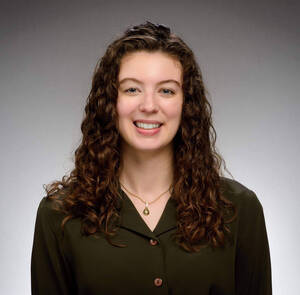
Meet Julia Wilson
I’m excited to share that Julia Wilson recently joined the internal communications team as our new associate editor! In this new role, she will take on some of OPAC’s editing work as well as write NDWorks stories and other content. Please join me in welcoming her to Notre Dame!
Q: What’s your background/experience in this field?
A: I earned a degree in journalism from the University of Missouri and spent time as a copy editor for the student newspaper and a reporter for the community newspaper in Columbia.
Q: What excites you about working at ND?
A: Contributing to the storied legacy of this institution and working with such amazing people!
Q: What’s your favorite project you’ve worked on?
A: My favorite pieces to write are feature stories, and I loved working on a project that highlighted outstanding area high school students for the Columbia Missourian. I was inspired and motivated by the hard work and positive outlooks that those students had.
Q: What makes a good editor/writer?
A: Curiosity. Being unafraid to ask questions and stepping outside of your comfort zone is essential to being an effective writer, editor, and communicator.
Q: What’s a fun fact about yourself?
A: I am fluent in Spanish and lived in Spain for a summer in college.
When to use Rev. or Father/Fr.
- On first reference, use the title Rev. This is a more formal title than many priests prefer, but it is still standard.
- On subsequent references, always use Father before the priest’s last name—Fr. is also OK to use; just make sure your content is consistent between the two.
- Use C.S.C. after a Holy Cross priest’s name on first reference. Note that unless C.S.C. falls at the end of a sentence, it should be followed by a comma: Rev. Robert Dowd, C.S.C., is the University’s president.
- Similarly, for religious in other orders, use the order’s initials (with periods) after the person’s name on first reference—e.g., S.J., O.P., O.F.M.
- Names of religious brothers and sisters follow the same format: Spell out Brother or Sister on first reference with their full name, and on subsequent references, use Brother/Sister with their last name.
Pop quiz
Please think of these monthly quizzes as open-book! I don’t expect you to know the answer off the top of your head. I designed these quizzes, in fact, to get readers more comfortable using the University Style Guide to find the answer. You are encouraged to consult that before submitting your answer.
March pop quiz winner
What we’re reading
Dragonfly Editorial
CMOS Shop Talk
Latest style guide updates
-
bestseller, best-selling
Following Merriam-Webster, the noun bestseller is one word, but the adjective form, best-selling, is hyphenated. -
co-
Following Chicago, words that begin with the co- prefix are generally not hyphenated: coworker, coauthor, coeditor, cooperation. Exceptions include words where the hyphen is needed for clarity: co-op, co-opt. -
pope
Pope is capitalized only when it appears before a name. Alternate titles, such as His Holiness or the Holy Father, are capitalized when used as a stand-in for the pope’s name.
- The encyclicals from Pope Francis can be found on the Vatican’s website.
- He was elected pope in 2013.
- He is the first pope from Latin America.
- The pope gave a blessing to the crowd.
- The Trustees last met with the Holy Father in 2024.